History


Rams Island Heritage Project  Supported By


Home
Island Warrior
Events
Biodiversity
History
Photo Galleries
Mission
Volunteers
Ballinderry
Links
Contact Us


Rams Island History

Rams is mentioned in the Annals of the Four Masters. Cumaighe, son of Deoraidh Ua Floinn, lord of Durlas, was drowned in Loch-Eathach (Lough Neagh), after the island of Inis-Draicrenn (Rams Island) had been taken by the Ui-Eatach, where forty-four persons were slain.

Derlas (Derlus, Durlais) - The location for a territory named Derlus is described by John O'Donavan in Ui Tuitre, co. Antrim.

As the Ua Floinn (or O'Lynn) are described as chiefs of Durlas in the 12th & 13th centuries, and McLysaght places them in southern Armagh (between Lough Neagh and the sea), perhaps the country of Derlas was on the Armagh-Down border. McLysaght cites the Ua Floinn lineage from Clanna Rury of Ulidia, tracing their descent Colla Uais.


Since the reference in the Annals for 'Inis Darcarcrenn' seems to be Ram's Island, near the eastern shore of Lough Neagh, the location of Derlas was likely in county Antrim. The Ui Tuitre of co. Derry are known to have moved west across the river Bann, into county Antrim, supplanting the lands of the Eilne branch of the Dal nAraide by the 10th century. Ua Floinn (O'Flynn, O'Lynn) were Ui Tuirtre leaders as were the later kings of Derlas.


The origins of its present name are largely surrounded by speculation. The earliest known name was Inis-Draicrenn/ Inis Darcarcrenn, and by the seventeenth century this had been anglicised to Ems/Enis Garden. The present name may have derived from the ending "raicrenn" of the original name being confused in pronunciation with the Gaelic word "reithe" meaning a "ram". Speed's map of Ulster, dated 1610, and Johan Blaue's map of 1654, both mark the island as "Enis Garden" and show the symbol of a church tower. It is on record that the ruins of a church were still visible near the Round Tower in the middle of the eighteenth century.


Further proof of ecclesiastical occupation of the site came in the late eighteenth and early nineteenth centuries when human bones including several complete skeletons and remains of coffins were occasionally dug up in the vicinity of the Round Tower. A number of brass fastening pins, probably for monks' cloaks or shrouds, were found in conjunction with the burials, and amongst the coins discovered was one of Edward I. A properly conducted archaeological excavation covering a wide area around the Round Tower would undoubtedly produce very interesting and important results.

The most obvious monastic relic is the Round Tower which stands on top of a steep eminence near the east shore of the island. It is constructed from fairly small rounded stones which may well have come from the island's shores, and is forty three feet high, but was probably somewhat higher when it was originally built. The original doorway was about eight feet above ground level on the south side of the tower, a more recent one at ground level on the west side was built up in the late 1960s to give the tower extra strength and to hinder vandals. Two fairly small windows survive further up the tower.

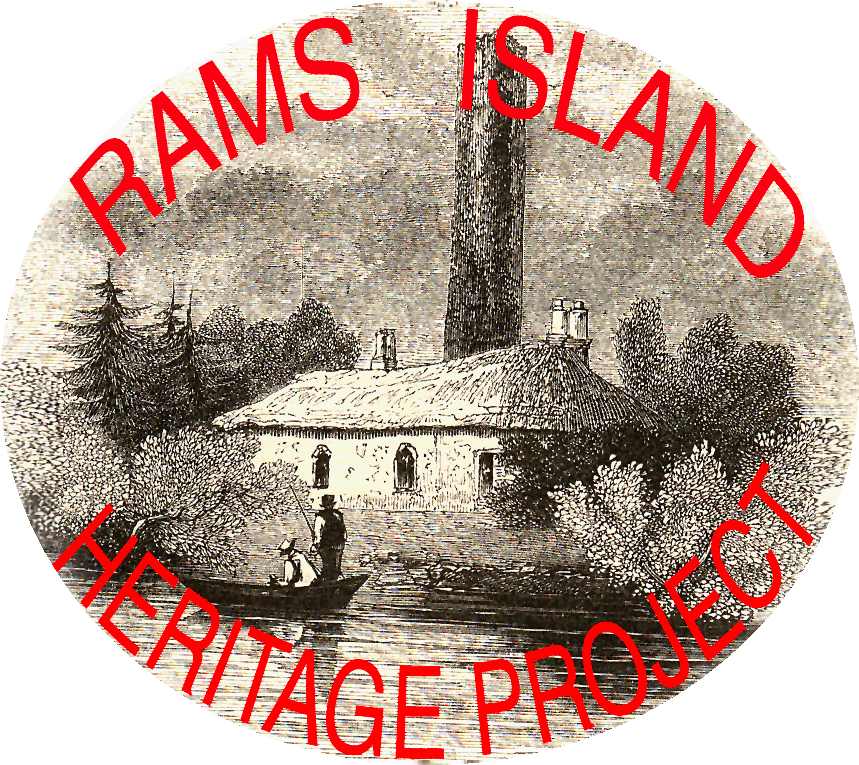
In the eighteenth century Ram's Island was owned by a fisherman named David McAreavy who sold it for one hundred guineas in 1804 to the Lord O’Neill. When Lord O’Neill bought the Island it was just over six acres and due to the four lowerings of Lough Neagh (some two metres in total) the Island has grown to some 40 acres. The pre McMahon Scheme (mid nineteenth century) waterline protected by rocks set into the banks can be followed around the original Island. The pre Shepherd Scheme (1930’s) waterline is marked by Cardwells Harbour. In the early nineteenth century the Lord O'Neill built a charming thatched cottage in the English style, just below the Round Tower. A cottage for a caretaker was also built.  Click here to download an article by the late Jim McGarry about the Cardwells and Rams Island (PDF 500kb)

During the Second World War the Island was a favorite spot for visits by the American Eighth Army Air Force stationed at Langford Lodge. One night during the war, vandals visited the island and burned down the cottage.


Another exciting activity on Lough Neagh during world war two was  the formation of a flying-boat base in Sandy Bay in the shelter of Rams Island. The entire bay was surveyed before laying down twelve flying-boat moorings with special rubber buoys and pick-up harness, also a number of marine craft moorings for attendant vessels and refuellers, plus four flying-boat moorings east of Rams Island (sheltered from westerlies). In order to guide the flying-boats and marine craft out into the open Lough, a number of navigation buoys (gas-lit, flashing) were laid out, tracking to the north of Rams Island and also to the south. Sunderland flying boats used these moorings and service facilities for the remainder of the war.

Sunderland and Tender

Lough Neagh, Rams Island and Sandy Bay played their part during the build up to the D day landings The first transatlantic service by PB2Y Coronado was operated by the U.S. Navy Naval Air Transport Service from New York to Sandy Bay, via the flying-boat base at Botwood in Newfoundland. Materials for the war effort were flown in daily to Sandy Bay.


Home | Island Warrior | Events | Biodiversity | History | Photo Galleries | Mission | Volunteers | Ballinderry | Links | Contact Us

This site was last updated 08-Oct-2007